
Why an ENT Surgeon for Rhinoplasty?
The nasal valve, the narrowest point of the nose, shapes both breathing and appearance. Aesthetic planning needs an airway assessment.
Op. Dr. Yaşar Okan Akın · · 9 min read
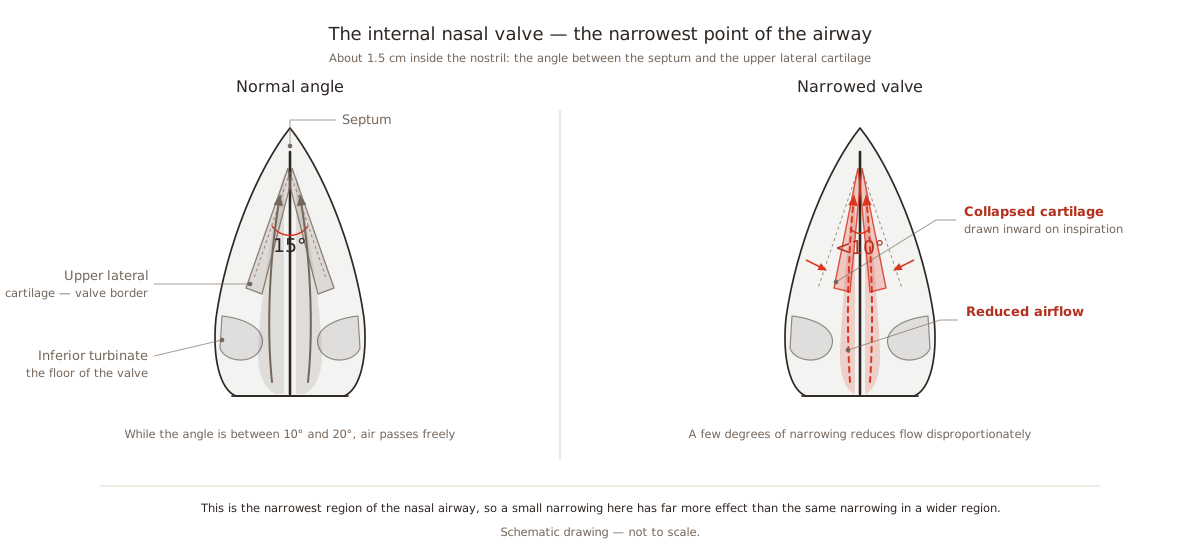
This is the most important article on the site, because the appearance of the nose and the way it breathes are two faces of the same anatomy. Treating them separately puts both the aesthetic and the functional result at risk.
The narrowest point of the nose: the nasal valve
About 1.5 centimetres inside the nostril lies the narrowest region of your entire airway. It is called the internal nasal valve.
Its boundaries:
- Medially, the septum
- Laterally, the lower edge of the upper lateral cartilage
- Below, the inferior turbinate and the floor of the nose
The angle between these is normally 10 to 20 degrees.
That range is not the same for everyone. Measurements vary markedly with ethnic background: a mean of 15.5 degrees in Caucasian noses against 22 degrees in Asian noses, with the spread across groups running from 10 to 50 degrees (Lee and Won 2024 — source 1 below). The same review notes that thicker skin in Asian noses helps protect the lateral wall against collapse.
The practical point: there is no single "normal angle." The assessment is made against a person's own anatomy and their own complaint, not against a textbook average.
Why do a few degrees matter this much?
Two laws of physics explain it.
Poiseuille's law — airflow is highly sensitive to the radius of the channel it passes through. In practice this means that one millimetre of narrowing at the tightest point does far more than one millimetre in a wide region. Because the valve is already the narrowest place, a small change there affects breathing disproportionately.
Bernoulli's principle — as air speeds up, pressure drops. When you take a deep breath the suction at the valve increases and a flexible side wall is drawn inward.
That second one explains a very familiar complaint: "I manage normally, but when I walk or run my nose blocks completely."
Two different kinds of obstruction, two different solutions
| Type | What happens | What is needed |
|---|---|---|
| Dynamic | The side wall collapses inward on inspiration | Support for the wall (batten graft, lateral crural strut) |
| Static | The region is permanently narrow | Widening of the region (spreader graft, flaring suture) |
The same complaint, two entirely different surgical answers. The only way to tell them apart is examination.
What the examination involves
More than a standard look is required:
- Nasal endoscopy — the back of the septum, the turbinates, the adenoid and any polyps can only be seen with an endoscope. Anterior rhinoscopy, a simple look, shows only the entrance of the nose.
- Cottle manoeuvre — the cheek is drawn laterally; if breathing eases, a valve problem is suspected. It does not show where exactly the problem is.
- Modified Cottle manoeuvre — different points of the valve region are supported one at a time with a small instrument. This locates the collapse precisely.
- Examination before and after a decongestant — separates how much of the obstruction comes from mucosal swelling and how much from structural narrowing.
How aesthetic surgery can damage breathing
The mechanism runs like this.
1. Removing a hump creates an "open roof". When the dorsal hump is taken down, the connection between the upper lateral cartilages and the septum is disrupted. The dorsum is left like a roof with its ridge removed.
2. Closing the roof narrows the middle vault. The bones are infractured to close the roof. If the upper lateral cartilages collapse inward during this, the internal valve angle falls below 10 to 15 degrees.
3. The result: breathing worsens, and so does the appearance. The visible counterpart is called an inverted-V deformity — a shadow line appearing where bone meets cartilage. In other words this is not only a functional failure but an aesthetic one.
4. Taking too much cartilage from the tip. The classical "narrow the tip" approach, if it removes too much from the lower lateral cartilages, can cause external valve collapse and retraction of the nostril rim.
The counter-measure: rebuilding the middle vault in the same operation with spreader grafts or a flap technique when the hump is removed, and adding support grafts to the nostril rim where needed.
So does adding aesthetic goals make breathing worse?
There is a good answer to this question.
A prospective multicentre study of 79 patients, across 10 centres with 12 surgeons, compared two groups: those who had functional surgery alone and those who had aesthetic work added.
- At baseline the mean obstruction score was 67.1 out of 100
- At three months the mean improvement was 48.6 points
- Functional only: −51.4 · Aesthetic plus functional: −46.6
- The difference was not statistically significant (p = 0.49)
The conclusion: as long as the valve is supported, adding aesthetic goals does not worsen the breathing result.
The reverse is also true: if the valve is not supported, an operation performed for appearance can damage breathing.
What the international guidance says
The American Academy of Otolaryngology–Head and Neck Surgery position statement on nasal valve repair states that:
- Nasal valve repair is recognised as a distinct surgical procedure
- Diagnosis rests on clinical examination
- It can be performed together with septoplasty and turbinate reduction
- And, most critically: failing to perform an indicated nasal valve repair frequently results in incomplete symptom resolution.
In other words, one of the most common reasons behind "I had a septoplasty but my breathing did not fully open" is a valve problem that was missed.
To be honest: every solution has a cost
These grafts have an effect on appearance, and not saying so would be an omission:
- A spreader graft can widen the dorsum somewhat
- A butterfly graft can create fullness just above the tip
- An alar rim graft corrects slight retraction of the nostril edge
Good planning means discussing this trade-off between breathing gain and appearance with the patient. An approach that promises everything will be perfect at once is not realistic.
In summary
Nasal obstruction can come from the septum, the turbinates, the nasal valve, the adenoid, polyps or allergy — or several of these at once. Telling them apart requires endoscopic assessment.
Aesthetic planning should not be done without assessing the airway. What ENT training contributes at this point is the habit of seeing the nose not only as a feature of the face but also as a respiratory organ.
This content is for general information only; please consult your doctor for diagnosis and treatment. Results of any surgical or interventional procedure vary from person to person.
Sources
- Lee DY, Won TB. Management of Nasal Valve Dysfunction. Clin Exp Otorhinolaryngol. 2024;17(3):189–197. https://doi.org/10.21053/ceo.2024.00073
- Yeung A, Hassouneh B, Kim JC. Outcomes of Nasal Valve Repair (prospective multicentre study). JAMA Facial Plast Surg. https://doi.org/10.1001/jamafacial.2015.1854
- AAO-HNS. Position Statement: Nasal Valve Repair. https://www.entnet.org/resource/position-statement-nasal-valve-repair/
- Carrie S, et al. NAIROS. BMJ 2023. https://doi.org/10.1136/bmj-2023-075445
Written and medically reviewed by
Ear, Nose and Throat Surgeon · Last reviewed:
Book a consultation
Let us establish the source of your complaint together, through examination and endoscopic assessment.