
Deviated Septum: When Is Surgery Needed?
A deviated septum is very common and most cause no symptoms at all. The decision rests on how much daily life is affected, not on what the scan shows.
Op. Dr. Yaşar Okan Akın · · 7 min read
What is the septum?
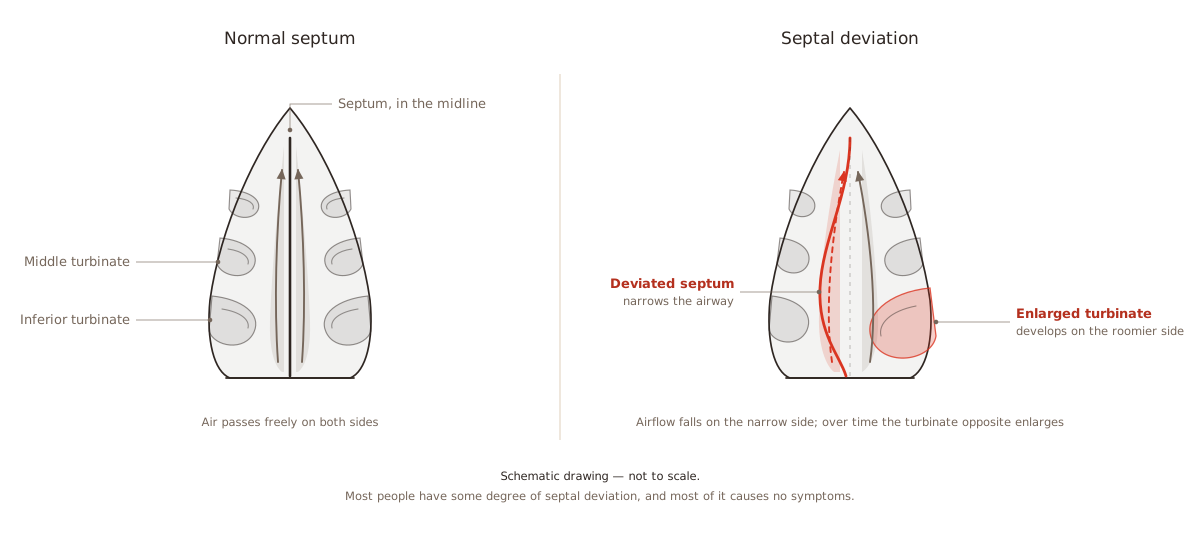
The partition that divides the inside of your nose in two is called the septum. Its front portion is cartilage, the back is thin bone. Ideally it sits in the midline and lets air pass equally through both nostrils.
A deviated septum is that partition bending to one side. It may be present from birth, follow an unnoticed knock in childhood, or arise from asymmetry during facial growth.
The most important point first: a deviation is not an indication for surgery
Most people have some degree of septal deviation, and most of these cause no symptoms at all.
This is the misunderstanding I correct most often in clinic. A large share of patients who arrive after seeing "septal deviation" written on a scan taken for another reason do not need an operation.
The decision follows the severity of the symptoms, not the appearance of the scan.
There is solid evidence behind this. The NAIROS trial, published in the BMJ in 2023 across 17 centres and 378 patients, showed that the benefit of septoplasty tracks the patient's baseline symptom severity: the gain was small in those with mild complaints and clearly marked in those with significant obstruction.
Which symptoms matter?
- Persistent, one-sided nasal obstruction
- Blockage that worsens at night, particularly when lying on one side
- Sleeping with the mouth open, dry mouth in the morning
- Snoring
- Recurrent episodes of sinusitis
- Breathlessness through the nose that becomes obvious on exertion
- Obstruction that does not clear despite nasal sprays
If these are lowering your quality of life, assessment is worthwhile. A deviation visible only on a scan is not.
Should medication be tried first?
Usually yes, particularly where allergy or mucosal swelling contributes. In the NAIROS trial the comparison group was treated for six months with an intranasal corticosteroid spray and saline.
However, a spray alone may not be enough for a structural deviation. In the same trial, at six months the surgical group's symptom scores were clearly better than the medical group's.
The practical approach: medication first, surgical assessment if it does not help.
How septoplasty is performed
The work is done from inside the nose — there is no external incision and no visible scar. The lining covering the septum is lifted, the deviated cartilage and bone are straightened or removed. The portion providing front and upper support is preserved, which is critical to prevent the tip of the nose dropping.
Turbinate reduction frequently accompanies it. The reason is this: when the septum bends to one side, the turbinate on the roomier side enlarges over time. Correcting only the septum can leave that side still blocked.
The procedure usually takes 30 to 45 minutes and same-day discharge is often possible. Times vary from person to person.
"Will packing be used?" — the answer has changed
This is patients' number one fear. And the good news is that current evidence argues against routine packing.
A meta-analysis covering 47 randomised trials and 4,087 patients found that packing:
- does not reduce bleeding,
- markedly increases pain (around 3 points on a 10-point scale),
- increases the risk of adhesions inside the nose,
- and causes disturbed sleep, difficulty swallowing and watering eyes.
The conclusion was unambiguous: routine nasal packing after septoplasty should be avoided.
Today's preferred method is securing the septum from the inside with a suture technique. NAIROS used this rather than packing.
One distinction worth making: the splint placed on the outside of the nose and the packing placed inside it are not the same thing. Patients often confuse them. In certain situations — a high bleeding risk, or another procedure performed at the same time — your surgeon may still consider packing necessary.
Recovery
| Time | What to expect |
|---|---|
| First 1–2 days | The nose feels blocked; blood-stained watery discharge |
| First week | A fullness like having a cold; no nose blowing, sneeze with the mouth open |
| ~1 week | Most patients return to work |
| 2–3 weeks | Avoid heavy lifting and sport |
| 4–8 weeks | Review appointment; the improvement in breathing becomes clear |
An important expectation to set: you may not feel the improvement straight away. One meta-analysis found no significant difference between the medical and surgical groups at three months, while a clear difference in favour of surgery emerged at six and twelve months. Patience is needed until the internal swelling resolves.
Risks
No operation is without risk. The rates reported in NAIROS:
- Infection requiring antibiotics: around 12%
- Change in the sense of smell: around 11%
- Temporary numbness of the front teeth and palate: around 11%
- Readmission for bleeding: around 4%
- Perforation of the septum: around 3%
Because complications were systematically asked about in that trial, these rates may be higher than what is seen in everyday practice. Even so, deciding with these figures in hand is the right way to decide.
The need for a second operation is low: an analysis of a large United States database covering 295,236 patients found a revision septoplasty rate of 1.1%. In NAIROS no patient required revision within twelve months.
Frequently asked questions
Will septoplasty also change the shape of my nose? No. Septoplasty concerns the internal structure and does not alter the external appearance. If breathing and appearance are to be addressed together, the operation is a septorhinoplasty.
Will a deviation correct itself? No. Surgery is the only way to straighten a deviated septum. But, to repeat, not every deviation has to be straightened.
Will it get worse if I do not have surgery? Without a new injury, a septum does not progressively bend further on its own.
Will my nose never be blocked again? That would not be an honest promise. Allergic rhinitis, sinusitis and turbinate swelling are separate causes, and septoplasty does not treat them. This is exactly why identifying the source of the obstruction before surgery matters so much.
Can it be done in children? The nose reaches most of its adult size at around sixteen, and the classical approach is to defer surgery until then. But severe obstruction has a cost of its own: continuous mouth breathing can affect facial and jaw development. The evidence here is limited and the decision has to be made for the individual child.
This content is for general information only; please consult your doctor for diagnosis and treatment. Results of any surgical or interventional procedure vary from person to person.
Sources
- Carrie S, et al. Effectiveness of septoplasty compared to medical management in adults with obstruction associated with a deviated nasal septum (NAIROS). BMJ 2023. https://doi.org/10.1136/bmj-2023-075445
- Nasal packing after septoplasty: a systematic review and meta-analysis. Rhinology. https://www.rhinologyjournal.com/Rhinology_issues/manuscript_2823.pdf
- Septoplasty versus medical management: meta-analysis. Eur Arch Otorhinolaryngol 2024. https://link.springer.com/article/10.1007/s00405-024-08937-x
- Revision Rates of Septoplasty in the United States. Facial Plast Surg Aesthet Med 2022. https://doi.org/10.1089/fpsam.2022.0009
- NIHR full report — NAIROS. https://www.ncbi.nlm.nih.gov/books/NBK601663/
Written and medically reviewed by
Ear, Nose and Throat Surgeon · Last reviewed:
Book a consultation
Let us establish the source of your complaint together, through examination and endoscopic assessment.